BUILDING FAMILY AND COMMUNITY RELATIONSHIPS
I am committed to building strong family and community partnerships by organizing events that foster engagement and support, including community children's clothing drives. These efforts help create meaningful connections and provide valuable resources for families.
Previously, I have struggled with the confidence to interact with families and their children, as it is one of the more intimidating aspects of early childhood education. However, as I have continued to step out of my comfort zone, I have gained the confidence to take action and initiate conversations to get to know families better. Through both conversations and school events, I have strengthened my connection to the community and improved my communication skills as an educator.

A Family Event:
Annual Clothing Drive
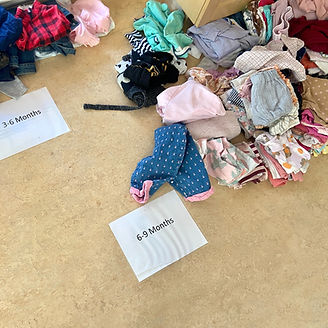
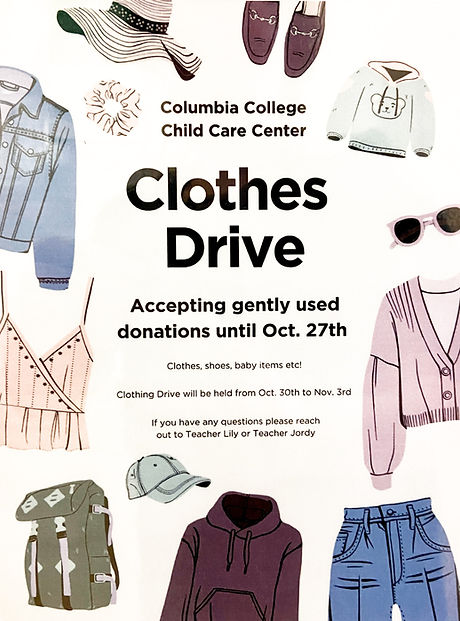
To strengthen my family and community connection, I chose to be involved in Columbia Child Development Center's annual Clothes Drive. At this event, families could donate children's clothing to be received by the center, and later shop through all of the organized items that were donated. I felt that this met the needs of the families, as the area where the center is located is low-income, and a sustainable and no-cost way to get clothes for children is a great way to support families in the community. While participating in this event, I became more aware of the needs and generosity of those at the center. I was amazed that there were hundreds and hundreds of clothing items donated. Even though this drive is held every year, I am still inspired by how much the small community cares, and was inspired to find another way that the center can help support the local families.
I have sustained my work in the community by bringing this event to the schools I have worked at in Chico, CA!


Family Interview
Additionally, to support my connection with families and learn more about the community of the students that I work with, I conducted a family interview with a parent of one of the children in the toddler class at the Columbia Child Development Center. This interview helped me prepare for professionalism and the family-teacher conferences that I will be involved in in the future. After discussing the questions that I had prepared with the parent, we had a more extended conversation about the child's home and family life, and I learned some crucial details about them. I now have a stronger relationship with the parent, and feel better equipped to support the child in the classroom.
I opted to conduct this interview with the family of a child who was newer to the childcare program, to really support getting to know them better. I also completed the Desired Results Development Profile (DRDP) for this child. Here is a summary of our interview:
The content from the interview below was edited to protect the family's confidentiality.
For this event, I coordinated with staff members about goals and timelines for the drive, organized and folded items of clothing, and interacted with families to help them find clothes for their children. In the end, each time, there were so many items of clothing that were donated that many were donated to a local community resource center for other families to enjoy.
Are there any things you would like to know about me, to begin with, that I can answer?
"I think you said you want to be a teacher, is that right? That's interesting, I'm an accounting major so I can't imagine what that's like."
Can you tell me about (child's) history with the Columbia Child Development Center- i.e., how long he has been attending?
"This is his first time in childcare, really. He does sometimes get taken care of by his grandparents; we did that a lot when he was younger before coming here. But I think he likes it so far, and I think the structure of it all is really good for him."
How would you describe (child)?
"He's a pretty outgoing kid, very energetic, and likes to play a lot. He doesn't have any friends his own age, really, except before coming here, most of the kids he plays with are like six or eight so he's just used to them. He's been really into the basketball games that we've been going to, and I think it would be good to get him more into sports. I want to put him in football, baseball, and soccer, and stuff as soon as he's old enough and see what he likes."
Can you tell me about a typical weekend day for (child)?
"On the weekends, we usually go to the park for a playdate or to a basketball game or stuff like that. When it's rainy or more relaxed and we're staying home he likes to play with the Hot Wheels at his grandparents' house."
Can you tell me about a typical mealtime at home for (child)?
"At home, we usually eat breakfast at 7:00, lunch at noon, and dinner early at 5:00, and lots of snacks. I'm worried that he'll get hungry so I feel like I'm constantly offering him snacks."
Can you tell me about some of your child’s favorite activities at home?
"He's been pretty into sports, which I don't think is too bad because y'know he's a big guy and I feel like it's a good way for him to get out his energy. So a lot of basketball and sports, and he loves playing with the Hotwheel cars and all the tracks that his grandparents got him."
Do you have any questions about (child's) DRDP?
"No, I think it's good, I know we'll talk about it later more in-depth, but I'm not concerned."
Are there any important things I should know as a teacher that might help me better support (child)?
"We've had some pretty big changes lately, so we're dealing with that, but he's a resilient kid and he seems to be doing well with all the stuff going on."
Are there any better ways I can better support your child?
"I don't think so, he seems to be liking it here and doing really well."
Do you have any suggestions for us at the center?
"No, I don't think so, but thank you."